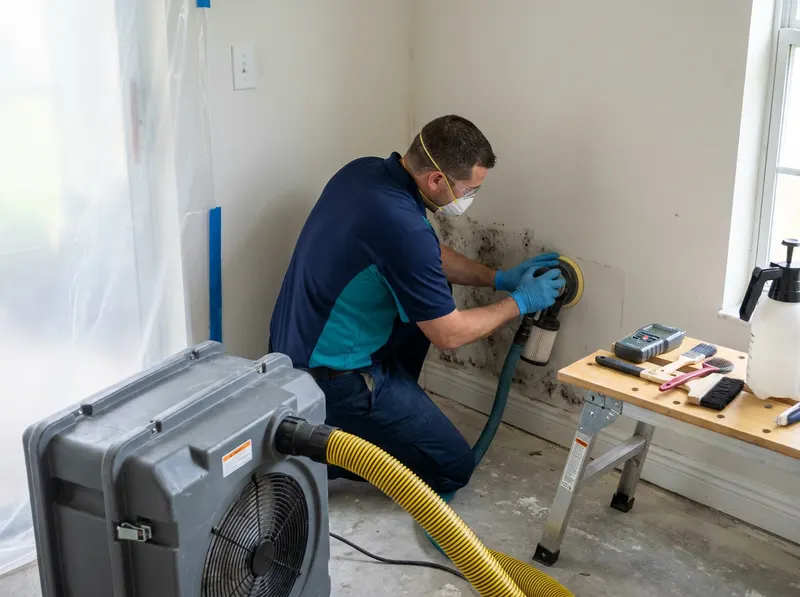
Mold in Orlando homes almost always traces back to standing water or high indoor humidity, which sits above 60% for much of the year in Central Florida. Common sources include A/C condensate line clogs, roof leaks after summer storms off Lake Underhill and Lake Eola, and slab moisture in older Colonialtown and Audubon Park bungalows. Remediation begins by fixing that water source; treating the surface without stopping the moisture guarantees regrowth within weeks.
The standard process runs in a set sequence. First, a moisture meter and thermal reading locate wet material behind walls. Second, plastic containment and negative air pressure isolate the work zone so spores do not travel through the HVAC. Third, HEPA air scrubbers filter particles down to 0.3 microns. Fourth, non-salvageable porous materials, drywall, insulation, carpet pad, are bagged and removed. Fifth, remaining surfaces get an EPA-registered antimicrobial and the area is dried below 16% wood moisture content before rebuild.
Decision-fit depends on the size and location of the growth. If the affected patch is under about 10 square feet on a hard, non-porous surface, spot cleaning with detergent and proper drying is often enough, and cutting out drywall is unnecessary. If growth exceeds 10 square feet, sits inside a wall cavity, or follows a sewage or long-standing leak, full remediation with containment is the correct route, the trade-off is a few days of a sealed-off room versus spores spreading to clean areas. Homes near Lake Nona and Baldwin Park with slab-on-grade construction see more baseboard and lower-wall mold; two-story homes in Dr. Phillips more often show ceiling and attic growth from roof and A/C leaks.
Air clearance testing is not part of every job. A visual-only remediation is common for small, clearly sourced growth. Post-remediation air sampling, sent to a third-party lab, is recommended when occupants have respiratory sensitivity or when a real estate transaction requires documentation; that testing adds roughly $300 to $600. Central Florida's humidity means prevention matters after removal, a dehumidifier holding indoor levels near 50% and a clear A/C condensate line are the two measures that keep colonies from returning.