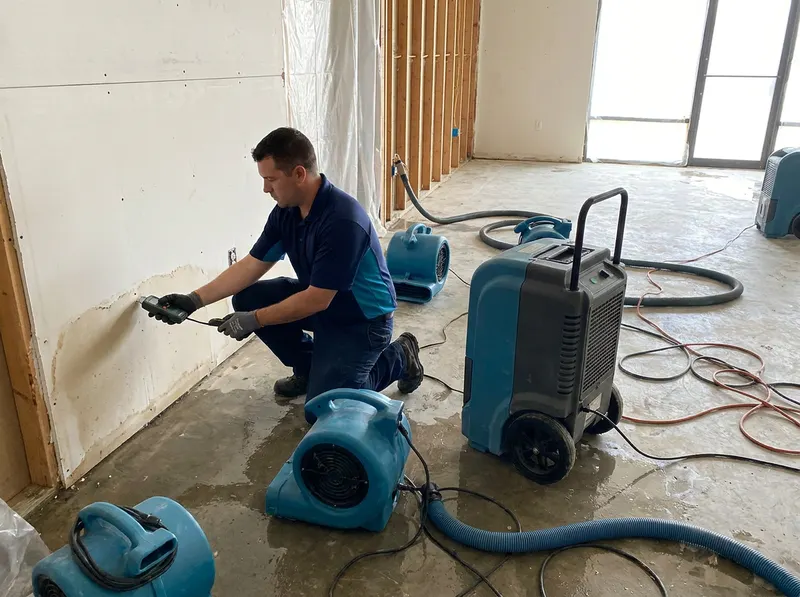
Commercial losses differ from homes because of scale, downtime, and shared systems. A single burst riser in a Downtown Orlando office tower can push water across two or three floors through ceiling grids and elevator shafts, so extraction and drying run on a wider footprint and a tighter clock. The first goal is to stop the loss from spreading into tenant spaces, server rooms, and stock, then to keep as much of the building open as the situation allows.
A commercial restoration sequence generally runs in five steps. First, a technician meets the property manager or owner on site and maps the affected area with a moisture meter and thermal camera. Second, truck-mounted or portable pumps remove standing water. Third, air movers and commercial dehumidifiers, often 10 to 40 units on a mid-size loss, are staged to pull the structure back to a dry standard, usually across 3 to 5 days depending on materials. Fourth, saturated drywall, insulation, and non-salvageable flooring are removed and the area is treated with an antimicrobial. Fifth, reconstruction rebuilds what was demolished so the space returns to use.
The right response depends on the building type and the water source. A restaurant kitchen near Mills 50 with a clean supply-line break often dries in place with minimal demolition, which keeps the dining room open. A ground-floor retail unit near the Mall at Millenia hit by Category 3 stormwater usually needs flood cut demolition, drywall removed 12 to 24 inches above the water line, plus antimicrobial treatment before rebuild. Warehouses near the airport and the 528 corridor add slab and racked-inventory concerns, where fast extraction protects palletized stock more than fast drying. Hotels along International Drive frequently need floor-by-floor containment so unaffected rooms stay rentable during the work.
Orlando's climate shapes the job: summer humidity routinely sits above 70%, so dehumidification, not just fans, carries the drying. Older buildings around the Orlando Health and Lake Eola districts often hold asbestos in floor tile or mastic, which requires testing before demolition on any structure built before roughly 1990. Documentation matters on commercial claims, daily moisture logs, photos, and equipment counts are recorded so the property owner and their insurer have a defensible drying file. Most commercial insurers accept IICRC S500 drying standards as the benchmark for a completed job.